

Spoilers and delicate topics warning — not recommended to read if you are sensitive. To clarify, the content of the actual manga is extremely sensitive. I don’t really intend to encourage anyone to read it unless they believe themselves to be “mature” enough to understand the manga’s true meanings and be prepared for the visuals it contains.
Books, comics, short stories, newspaper mini stories, etc., are all popular. But there’s a genre, which although it’s just as famous as these others, is not talked about as much as it should be. That type of story is called manga, and in manga, the story that stands out the most is “Berserk.”
What is “Berserk”?
“Berserk,” a manga written by Kentaro Miura — who, unfortunately, passed away on May 6, 2021 — is considered to be one of the best if not the best manga there is on the planet. “Berserk” is set in Europe’s medieval ages. Some think the story is specifically set in France, Scotland, or Germany, but this has never been confirmed. Therefore, we know there are kingdoms, no fireguns, and no other futuristic inventions, just men fighting with shields and swords. “Berserk” is extremely famous for Miura’s outstanding detail of drawing, how cool-looking Guts is, and for how deep the story is. 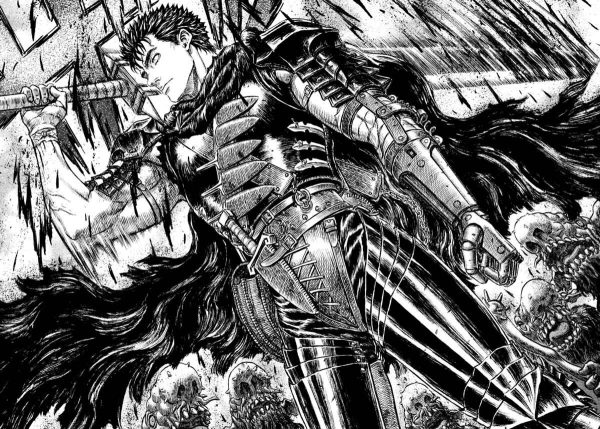 The story covers many topics, such as physiological, philosophical, sociopolitical, and sexual abuse themes. These types of mature topics is why Berserk is also considered as a vastly sensitive manga for anyone to read. But although these topics might appear grotesque and distorted to read, they’re not something that should make you not want to read it. But you have to understand why.
Why Should One Still Want to Read Berserk Despite Its Delicate Content? How Can One Understand It?
For one to understand why and how such topics are or can be used to make a story be catchy and “good” to read, one needs to accept a simple fact: it’s fiction. It is true the things that are shown in “Berserk” like: sexual abuse, nudity, violence, nonsense violence, ambition for power, betrayal, loneliness, trauma, and others are all a serious deal in the real world. But understanding that what you are specifically reading is just fiction is key so you don’t feel intensively gross by what you’re seeing and reading.
Readers also have to understand that these topics are not used by Miura without a good reason. Miura uses these subtle themes to show a real face of the true world. Therefore, it doesn’t mean that you should ignore them, pretend that they are pointless, and not think that they are stupid.
Before getting into the story of “Berserk,” it’s necessary to clarify that these themes should not be romanticized nor taken extremely seriously or personally (depending on how you look at it), which is what a lot of people mistake when reading or deciding to not read “Berserk.”
“Berserk’s The Blackswordsman Arc” Summary
It’s time to talk about the “Berserk” story from the beginning: “The Blackswordsman Arc,” to the end of “The Golden Age Arc.” “The Blackswordsman Arc” is a highly engaging introduction to the story of “Berserk” and Guts’s character. In this arc, we see Guts as the famous “Blackswordsman,” who’s a bloodthirsty man that seeks for revenge against a person who he once considered a friend, even family. As Guts is on his “mission,” he is also seeking to take out a Count who’s also a demon, or better called an apostle. Guts meets a vast amount of enemies and even sees some “familiar” faces that readers understand later in the manga series. Guts murders dozens of hundreds of enemies in grotesque ways, showing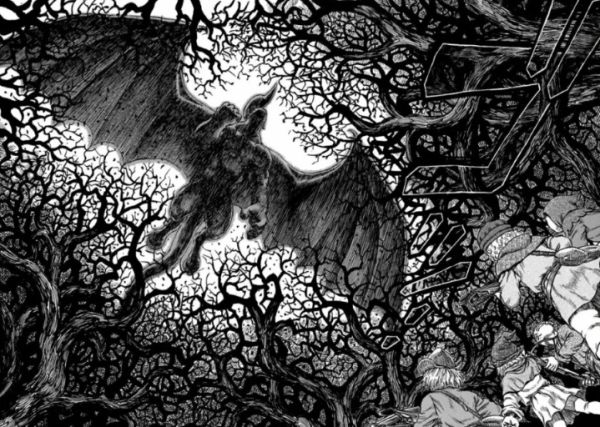 neither mercy nor any regret; he doesn’t care about who gets in his way whether they are good people or not. In Chapter 2, Guts says, “If you’re always worried about crushing the ants beneath you . . . you won’t be able to walk.” From what Guts says, we can see his true personality: brute, cruel, careless, however, traumatized as well. As Guts continues to murder armies and apostles, he eventually is taken down. When Guts is tortured, he shows no fear. Instead, he creates fear among others. The man who was torturing Guts was the Count himself, who had heard about Guts before. Because of that, he was expecting Gut’s arrival to try to kill him, which was no surprise to the Count. After some torturing sessions, Guts is extremely exhausted and wounded, but an elf who Guts had met on his way to kill the Count helps him to heal quickly and to be ready to escape. That Elf’s name is Puck, a character widely loved in the “Berserk” fandom. As Guts is healed and escapes along with Puck, they are being chased by the Count’s mercenaries. Guts, as always, doesn’t seem to care about Puck and just keeps running leaving him behind. But then, they encounter a mysterious man who says he can help them, Guts decides to follow him as he doesn’t have any other options. From then on, the story begins to turn more ravage, grotesque, and deep. Guts encounters the Count again and they fight till death. In that event, all the environment, mood, context, and people remind Guts of his greatest trauma. There are many things to mention about this arc that I have not, but if you are curious now, then you should read it. However, if you’re still unsure, the next arc should catch your eye.
 “Berserk’s Golden Age Arc” Summary
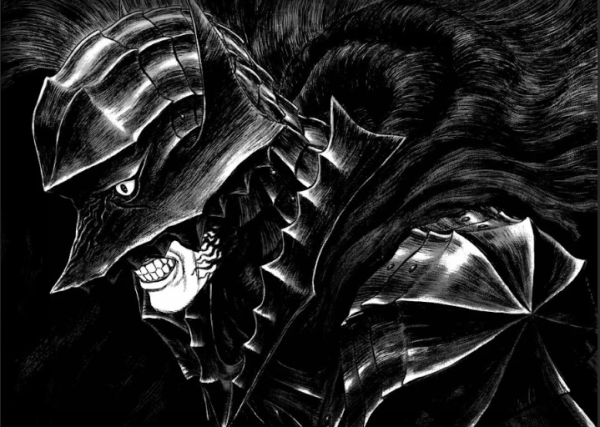
This arc is considered to be the best one of all in “Berserk.” This is practically the most important arc in all Berserk, as its breakpoint is the whole story’s plot. After “The Blackswordsman Arc” ends, Miura sets the new arc in Guts’ distant past, when he was an orphan — a newborn baby who was found by a woman that was within a group of mercenaries.
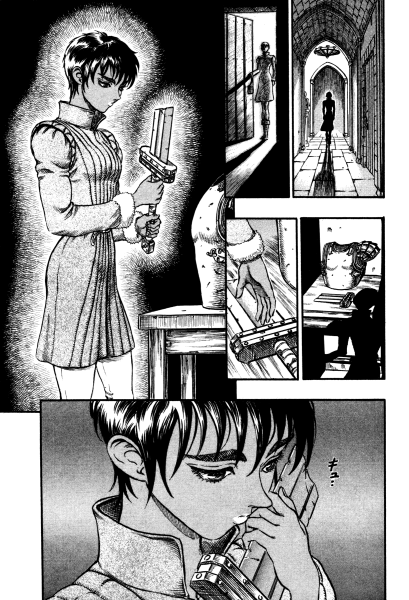
Guts as a kid knew nothing more than to wield a sword, usually bigger than him. In his childhood, he experienced many traumatizing events, like being abused by a man who bought Guts from what was the closest person to being his father figure. As Guts grew, he left that group and became a solo mercenary who worked only if he got paid, not for glory. It’s clear that “The Golden Age Arc” contains Guts’ backstory of who he was before he became a soulless, bitter person. It also includes how Guts keeps growing up throughout the years while being in another group of mercenaries he joined: The Band of the Hawk. There, he gets to live the best era of his life, as he meets people that he enjoys being with, Guts felt like he had found the place where he belonged. This is because all the members of The Band of the Hawk are young men like him. However, a single, and also young, woman warrior accompanied them as well. Her name is Casca, a character who does not like Guts, nor does Guts like her at first. However, they build up a better relationship throughout the arc, until they end up becoming something more than just comrades.
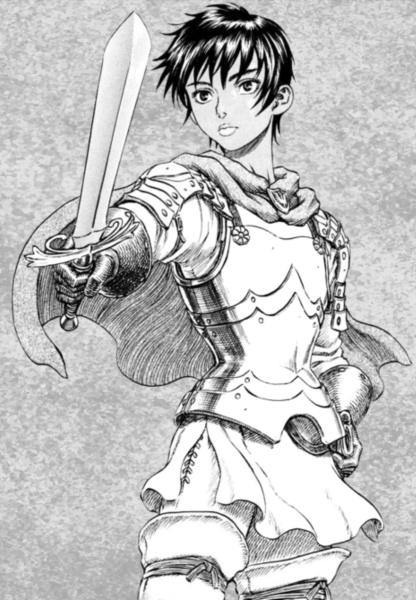
Just like Casca, there are other characters that are important in this arc, some of them being; Judeau, Rickert, Corkus, Pippin, Gaston, Princess Charlotte, King of Midland, Nosferatu Zodd (apostle), and many more. But out of all of them, besides Casca and Guts, there is one that stands out the most. That is Griffith, a man whose appearance is like that of a woman, the leader of The Band of the Hawk. Knowing why his appearance is similar to a woman’s is very important so you can understand the significance of it later in the story. Griffith and Guts are extremely close friends ever since Guts lost to him in a duel and had to become a member of the Band of the Hawk. But even despite being practically forced to join the group, Guts still appreciates Griffith.
Griffith is someone with a dream of becoming a king, having his own castle, and having his own army. This is a dream that he has had ever since he was a kid in the streets. But as much as it sounds all rainbows and happiness for now, the story slowly turns into a deep dark reality of what Griffith’s dream and friends truly means for him. While his dream is everything for him, his “friends” are only subjects for him to use in order to achieve his dream. He thinks that only those people who have dreams of their own can be at this level to be called his friends, those who do not possess a dream of their own cannot. Griffith later sees the consequences of his ideology and actions while trying to achieve his dream.
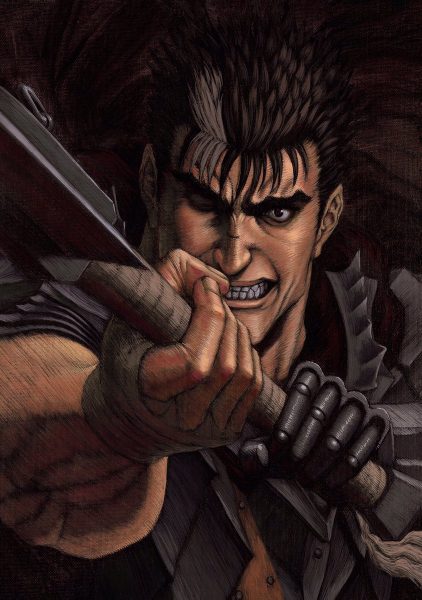 As the story progresses, things turn worse for Griffith, Guts, Casca and the rest of The Band of the Hawk. This arc is the most explicit of them all, while the Blackswordsman arc is already cruel itself, this arc is much more than the first one. It goes from a happy, thrilled, and joyful era to the most traumatizing event that the Band of the Hawk will live, “The Eclipse.”
What is the Significance of These Arcs?
As much as “Berserk” is an intensely, bloody illustrated piece of work, it has a true, emotional and deep meaning. “Berserk” can represent many things whether it is depression, redemption, trauma, happiness, hope, or love. “Berserk” contrasts a lot of topics that may mean something different depending on the context and cause.
A clear example of this is “love.” Love in Berserk, more specifically in this arc, is portrayed in various ways: obsessive love, true love, unhealthy love, and/or harmful love (abuse). What Guts lived as a kid left him a severe trauma of not liking being physically touched, whether it’s just a slight touch on the shoulder or hug. Due to that, Guts grows as a relentless and bitter person through his childhood and adolescence. When someone tries to touch Guts, he either pushes away whoever is touching him or directly attacks that person. However, Berserk also shows that some traumas can heal sometimes. As Guts spends time with The Band of the Hawk, he learns how to care, how to feel appreciation from others and appreciate them back. But most importantly, he learns how to truly love. When Casca and Guts have sexual relations later in the arc, their “act” might look like something unnecessary to illustrate, and it is true in great part, but the meaning of the “act” is what matter the most. Just like Guts, Casca also experienced sexual abuse and had to depart from what was her childhood hometown. What Guts and Casca understood about love was that it’s cruel and selfish. And it of course can be like that, just as it can be something good and king. In the act, Guts begins to remember his abuse, he begins thinking about his trauma as what’s happening with him and Casca is practically similar, but what made the difference is that Guts and Casca intend it with true love. Guts starts hurting Casca without even noticing until he wakes up from his illusion. Guts tries to walk away in shame for what he was about to do. However, Casca, instead of being mad at Guts and letting him walk away, she stops him as she understands him and what he feels and why he tried to do that to her.
“Berserk” shows how love can mean different things, how the same thing can be seen differently depending on why and how it happens. But just as Miura talks about in how many ways love can be different, he also talks about how ambition for power can corrupt a person.
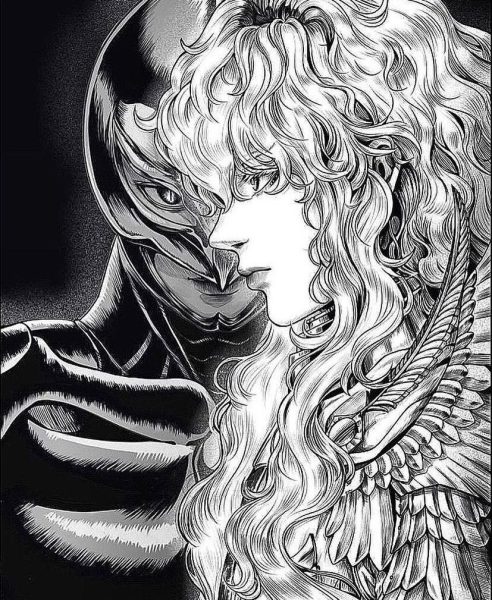
All student readers from Casa read the play “Macbeth,” by William Shakespeare, in their sophomore English classes. It is easy to see that the character of Griffith is extremely similar to Macbeth, literally and figuratively. Both Macbeth and Griffith desire for a kingdom of their own and they would commit any deeds necessary to achieve their dream. In Act 1, Scene 7, when Macbeth states, “I have no spur / To prick the sides of my intent, but only / Vaulting ambition, which o’erleaps itself,” he acknowledges that he has no true reason for letting his ambition of power decide to kill King Duncan. Similarly, Griffith acknowledges as well once it’s too late to change his actions. All these examples clarify how Miura portrays Griffith’s ambition as something that can corrupt anyone little by little, making Griffith inhumane and paranoiac due to what he has done in an attempt to fulfill his dream, just like Macbeth.
Once you start reading “Berserk,” you can see how well it works for the manga series to begin its setting after the Golden Age arc rather than moving chronologically. The reason why this works incredibly well is due to how Guts’ character will be understood by the readers. If Miura had done things in a chronological order, meaning that “The Golden Age Arc” first and then “The Blackswordsman,” Guts would simply appear as someone who changed due to a trauma. Yes, it is true that the reader would still sympathize with Guts. But making “The Blackswordsman Arc” be first and then following it with “The Golden Age 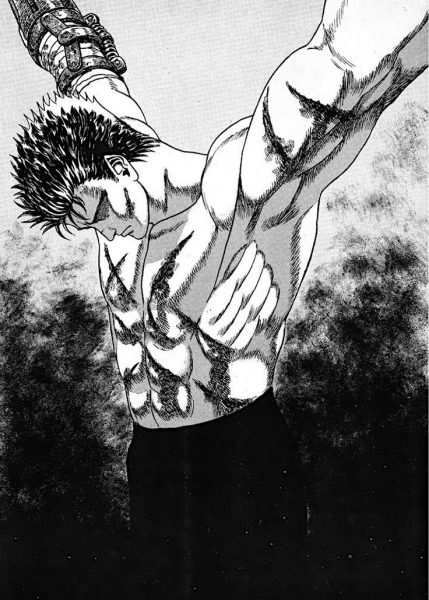 Arc” has a greater impact on the reader. We go from seeing Guts as a nonsense violent character to seeing him as a victim and understanding why he later becomes that kind of person: bitter, soulless, and depressed.
“Berserk” symbolizes an incredible amount of subjects, whether they are beautiful, sad, and cruel. “Berserk” could be basically interpreted as how real life is, containing many beautiful things, many sad things, and many cruel things…
At least that’s how I see it from my perspective.
“Berserk” Main Review
After these complex explanations with some few spoilers, it’s time for me to determine if I would recommend this manga to anyone. You, the reader, saw how I explained “Berserk” as much as I could and how it shouldn’t be understood. Because of that you probably already know what I will say, right? Yes? Well, no, I would not recommend this manga to anyone who’s under 18 years old, or at the very least, I would say no one younger than 16.
All joking aside, if you decide to read it, be careful. The topics and art that “Berserk” contains can sometimes be extremely grotesque and sensitive, just as sometimes it can be beautiful. “Berserk” is complicated, and it’s not for everyone to read. But if you think that you are able to read it and understand it well enough, then I would absolutely encourage you to read it. If you are not ready, then don’t read it yet.
Berserk Art
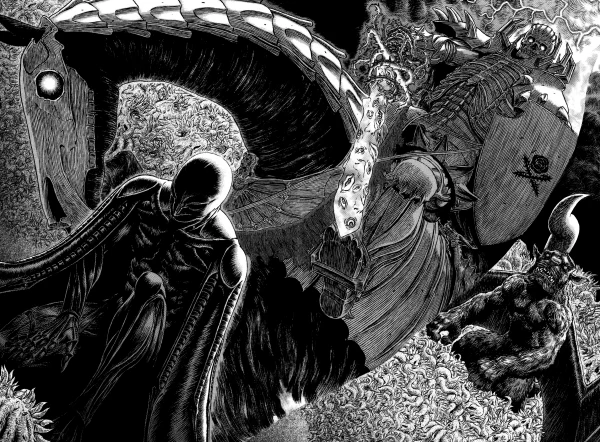
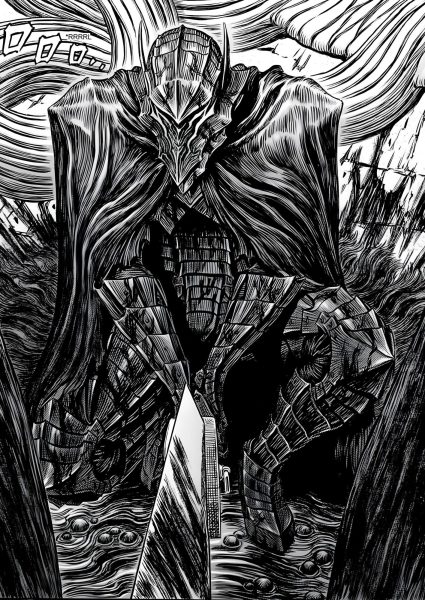
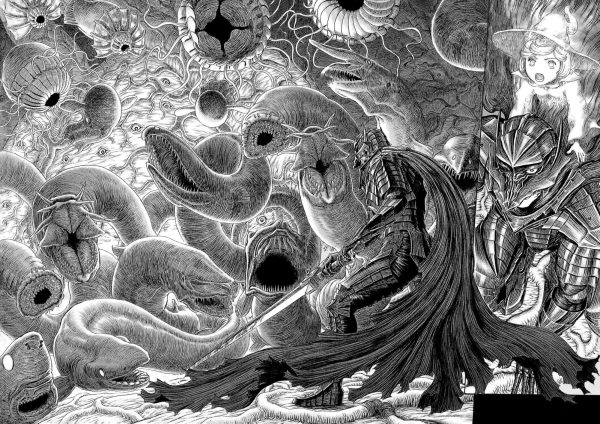
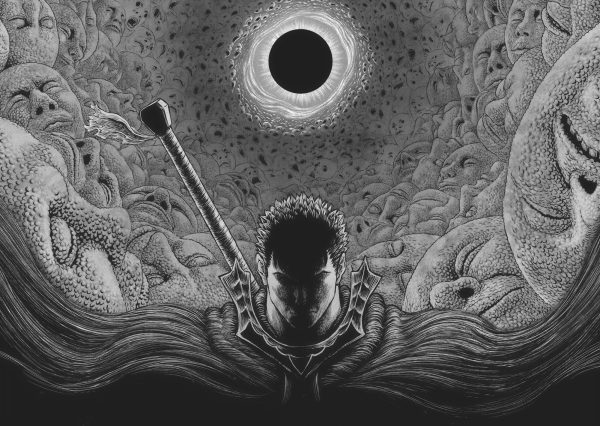
Berserk’s art is incredibly detailed, it’s considered to be one of the best arts among all illustrated
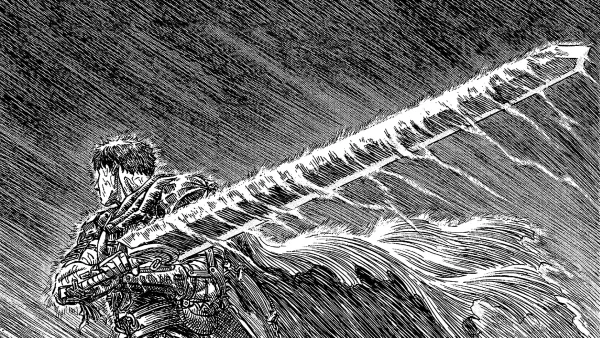
stories. Miura’s great art work has left every manga reader speechless.