
July 5, 2022
One notification changed everything.
Within minutes, phones buzzed across crowded cafés, airport terminals, and living rooms as the devastating headline spread: Alexia Putellas had torn her ACL just days before the Euros. Fans refreshed their feeds hoping it was fake, reposted screenshots in disbelief, and watched as Spain’s Euros hopes seemed to collapse before the tournament had even begun.
In football, injuries happen every season. Players recover, teams adapt, and tournaments move on. But this time, the reaction felt different. The shock surrounding the injury revealed something statistics alone never could: Alexia’s value extended far beyond goals and assists.
Even when she isn’t scoring or dominating matches statistically, her composure, leadership, and presence completely transform the rhythm, confidence, and identity of both FC Barcelona Femení and the Spanish national team.
 At the time of the injury, Alexia Putellas was not only the best player in the world, but also the face of a rapidly growing era of women’s football — she became far more than just a midfielder for FC Barcelona Femení. As Barça rose into one of the most dominant teams in the world, Alexia’s legacy intertwined with the identity of the team. While her back-to-back Ballon d’Or awards highlighted her individual brilliance, they did not fully capture the influence she has on the pitch. Her intelligence on the ball, composure under pressure, ability to dictate tempo, and presence that elevates the confidence of the players around her has made her far more than just a goalscorer or playmaker. It has transformed the way both Barça and Spain play. Alexa Martinez, a junior at Casa Grande, agrees, saying “when [she watches] Alexia play, it feels like she always knows what is going to happen before everyone else. She makes the game look easy even when it isn’t.”
Although Alexia’s influence is unlike any other player in the women’s game, it cannot be fully understood without also looking at the intelligence and skill that makes her such a special player in the first place. It is her understanding of the sport that allows everything else in her game to exist — from her calmness under pressure to her ability to dictate tempo. Her awareness and ability to read the game are what sets her apart.
What’s truly unique is not just her ability to read what is happening in the game around her, but knowing exactly what to do with that information right away. Many players can see space or recognize patterns, but few are able to consistently turn that awareness into decisive actions that can control a match like she can.
This ability is what allows her to consistently find and execute perfectly timed passes with precision, but it also defines how she operates as the 10. Rather than staying fixed in one area, she is constantly finding pockets of space between the lines, positioning herself where she can both create and progress plays for her team in a way other players do not. This movement and spatial awareness allows her to control matches without needing to dominate them physically or having to stand out from other players.
Beyond her intelligence and positional awareness, Alexia also has a level of technical quality that makes her incredibly difficult to stop. She is not a flashy player in the sense of showing off skills just for the sake of it, but instead she uses her technical ability in a way that is both efficient and creative.
Whether it is her flawless touches out of the air, her close control in tight spaces, her ability to glide past pressure with subtle dribbles, or just the precision and imagination in her passing, everything she does feels purposeful and intentional. There is a creativity to her game that doesn’t disrupt structure, but enhances it — turning small moments into clear advantages for her team. Watching her at her best, especially prior to her injury, almost feels effortless, as if she always has an extra second on the ball that others don’t, and she uses it to make the game look simpler than it actually is.
Once she got injured, her absence didn’t just leave a gap in the midfield, it changed the entire atmosphere on the pitch. Although both Barça and Spain still possessed world-class talent, there was a noticeable difference in the way they played without her. Her influence in a match was not something that could simply be replaced.
The change was not always obvious in the final score, but in the way the game itself felt. Possession appeared less controlled, transitions became more rushed, and moments that would normally be managed with ease carried a greater sense of uncertainty. Alexia’s presence acts as a bridge between different phases of play, connecting teammates and bringing structure to the team as a whole.
This is what made her absence so significant. It was not merely the loss of a world-class midfielder, but of a player whose influence extended far beyond her individual contributions. Without her, both Barça and Spain remained strong teams, but her injury revealed just how much of their composure, balance, and identity had been built around her presence. “You could tell the teams were still good, but they just didn’t feel the same without her. It was like something was missing, even if you couldn’t always explain exactly what it was,” Martinez says.
In many ways, her injury highlighted something that is often only understood in hindsight: certain players are not only important because of what they do with the ball, but because of how they organize everything around them. And when those players are missing, the change is not always obvious on paper, but is undeniable when watching the teams play.

Over time, as her teams adjusted to her absence, the focus slowly shifted away from the shock of her injury and towards the question everyone following women’s football was asking: when would she return, and would she be the same player again? For Alexia Putellas, the recovery process became its own story, followed closely not just by fans of FC Barcelona Femení, but by the wider football world. Every update carried weight, because her absence had already made her importance impossible to ignore.
As months passed, her recovery steadily progressed, and the possibility of seeing Alexia Putellas back on the pitch began to feel real again. Training footage, small cameos, and gradual returns to the squad were followed closely, each step carrying more emotion than statistics could explain.
Her return, however, was not an overnight success story. The road back was long, and the journey did not end the moment she stepped onto a football pitch again. Even after returning, recurring issues in the same knee continued to disrupt her progress, eventually leading to another procedure and more time away from the game. She spent months rebuilding confidence, regaining fitness, and adapting to the demands of elite competition. Match by match, she worked her way back toward the level that had once made her the best player in the world.
When she finally returned to the pitch, the moment carried a weight that went far beyond football. Every touch was watched closely, every movement met with a reaction that reflected not just excitement, but relief — as if the game itself had regained something it had been missing. For Barça, it was not simply the return of a player, but rather the return of control, familiarity, and leadership. Almost instinctively, the rhythm of the team shifted once again, reorganizing itself around her presence. Yet, even after everything, her comeback story still felt unfinished. That was until Bilbao.
Bilbao had already set the stage for the 2024 UEFA Women’s Champions League final, as Barça arrived once again at the end of another European campaign, chasing yet another title at the very highest level. For days leading up to the match, much of the attention surrounding the final had drifted away from tactics or form, and toward one lingering question: Would Alexia Putellas actually play?
As the match unfolded, it remained tightly contested, with neither side able to fully take control for long stretches. Every pass, tackle, and transition carried weight, as Barça fought to hold onto their narrow advantage in a final that still felt far from decided.
By the time the clock moved into the final minutes, the tension inside the stadium had become almost unbearable. The 90th minute arrived, and still there was no sign of Alexia
Putellas on the pitch. Fans were on the edge of their seats, every glance toward the sideline carrying the same question: would she come on, or would the game pass without her involvement?
And then, in the final moments of the match, the fourth official’s board finally rose. The number 11 went up in green, and the stadium reacted instantly. As she made her way to the sideline, the atmosphere shifted completely. Chants of her name erupted around the stadium, growing louder with every step she took toward the pitch.
She stepped onto the pitch with only a few minutes remaining, but her presence changed the rhythm of the game almost instantly. Barça looked calmer and more controlled, as if the winner had already been decided.
Barely four minutes after coming on, the play began to unfold. Ona Batlle, from left-back, picked out a perfectly weighted through ball into the edge of the box, slicing through the defence with precision. Clàudia Pina latches onto it, driving it toward the goal line before cutting it back towards the middle, where Alexia Putellas was already arriving. With the ball sitting up perfectly, she struck it first time, curling it beautifully into the top-left corner, a finish that felt inevitable the moment it left her foot. Sealing the match for her team.
For a brief moment, the stadium seemed to freeze and then it erupted, the commentator’s voice cut through the noise as the ball hit the net: “It was written in the stars.” Alexia immediately tore away in celebration, instinctively pulling off her shirt as she sprinted toward the corner flag. Cameras locked onto her as she bowed toward them, the stadium still roaring around her. Behind her, Lucy Bronze lifted her jersey in celebration, while teammates flooded toward her in a wave of relief and emotion.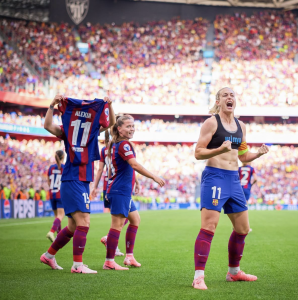
For a brief moment, everything she had been through — the injury, the setbacks, the long road back — felt compressed into that single scene. “That goal felt bigger than football. Even if you’re not a Barça fan, you knew how much work it took for her to get back to that moment,” said Martinez.
Moments like that are exactly why Alexia Putella’s influence cannot be measured in simple statistics. The goal itself was important, but what it represented carried far more weight — a reminder of how deeply she is connected to the identity and rhythm of FC Barcelona Femení. It was not just a return to form, but a return to everything her absence had taken away from the game’s structure, confidence and emotional balance.
More than anything, her story shows that leadership in football is not always loud or visible on a scoresheet. It can exist in the way a team moves, the way players make decisions, and the way an entire match feels when one individual is on the pitch. Alexia Putellas is not only defined by what she has achieved, but by the space she creates for others to perform at their best. And that’s why her presence, even beyond goals, trophies and awards, continues to shape the way football is played and understood.
In many ways, the environment she helped build at FC Barcelona Femení has now become something that extends beyond her own role within it. The platform she elevated is now one that allows a new generation of players to thrive within the standards she helped set.